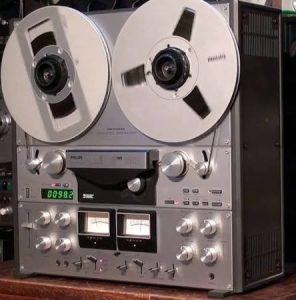

Nakamichi K.K. (jap.)Nakamichi Corporation, Nakamichi is a Japanese manufacturer of high-end entertainment electronics and was a pioneer in the development of high-quality cassette decks.
Etsuro Nakamichi founded the company in 1948 in Tokyo as the Nakamichi Research Institute. The focus was on electromagnetism, magnetic recording technology, acoustics, and communication.
In 1973, Nakamichi was one of the first manufacturers to introduce recorders with three playback heads, the Nakamichi 1000 and the Nakamichi 700. This allowed for directRewind controlpossible, meaning monitoring or controlling the recorded music signal while the recording is still in progress.
In the 1980s, Nakamichi's most famous device was the legendary cassette deck Dragon. Another exclusive feature of Nakamichi was the so-called UDAR cassette decks (UniDirectional AutoReverse) of the RX series. Here, unlike conventional auto-reverse devices, the tape head was not flipped at the end of the tape or at the push of a button, and the tape direction was not reversed, but the cassette was rotated in the device via a special mechanism. This happened just as quickly as switching in conventional devices.Tape direction.
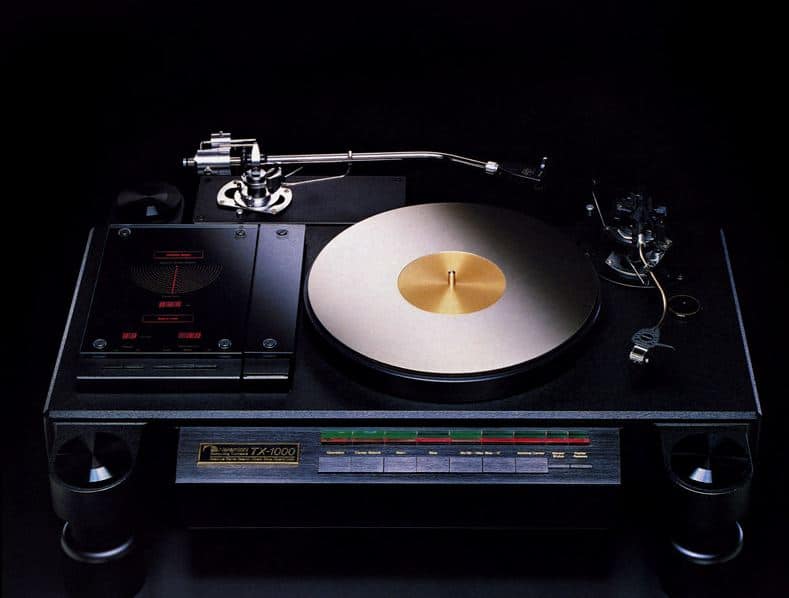
Nakamichi also produced all other components of a typical stereo system in the 1980s, but despite high quality, they never reached the fame and distribution of cassette decks. One explanation for the rather low market success is the design, which was futuristic and rather sober with partly angular geometric shapes, with the devices mostly being black. Other manufacturers of HiFi products better matched the customer taste of the time.Moreover, Nakamichi never offered a wide range of devices in various price ranges like other manufacturers.
The program included the high-end turntable TX-1000, which cost about 20,000 DM (around 20,000 Euros). Many of these devices are still sought-after used items today, like the 27 kg power amplifier PA-7e from the late 1980s with 2 × 330 watts. This cost about 4,500 DM, around 4,000 Euros. The corresponding preamplifier CA-7e cost 7,000 DM, now around 6,200 Euros. Both devices are still traded used at prices well over 1,000 Euros each.
In the 1990s, Nakamichi also built CD changers that could hold up to 7 CDs. During the 1990s, cassette decks were gradually pushed out of the market. With the cassette decks, the strongest revenue generator also disappeared. Until 1993, the company was also present in the European market but withdrew due to sales and marketing problems.
On February 19, 2002, the company filed for bankruptcy under the Civil Rehabilitation Act with a debt of 20 billion yen (170 million euros). By May 31, 2008, Nakamichi ceased the distribution of Nakamichi products. In the meantime, Nakamichi has become a renowned manufacturer of car Hi-Fi systems, mainly used by Japanese car manufacturers.
The founder of Nakamichi
Etsuro Nakamichi founded Nakamichi Research in 1948. The brother of Niro Nakamichi, he was an acoustic engineer and officer in the Japanese Navy. In the beginning, Nakamichi designed and developed portable radios, tonearms, speakers, and communication devices. The company he later founded developed some of the world's best cassette decks, including the world's first 3-head cassette deck. At one point in the mid-1960s, the company produced tape decks for a number of foreign companies like Ampex,Harman Kardon and Motorola. His company was also the first to license Dolby-B Noise Reduction from Dolby Laboratories in 1969.
Etsuro Nakamichi Foundation
The foundation dedicated itself to the promotion and development of classical music according to Etsuro's wishes.
Takeshi Nakamichi
Etsuro's only son, Takeshi Nakamichi, joined the Nakamichi Corporation in April 1972. Takeshi is currently the president/representative of the Nakamichi Corporation.
Niro Nakamichi
After Etsuro Nakamichi founded Nakamichi, his brother Niro joined, and the two brothers worked to develop the company. In 2001, Niro Nakamichi, designer of many of the historic tape decks, started a new company, Mechanical Research Corporation, that developed ultra-high-end audio amplifiers and preamplifiers. However, the products were no longer developed, and a series of home theater products were introduced. The company was renamed Niro Corporation.