I've never seen this cult turntable live.
There are turntables built to reach as many buyers as possible. Others are meant to look good. And then there's the Technics SL-M3: a device that apparently came about because Japanese engineers wanted to show what’s technically possible when cost, weight, and mechanical effort aren't the top priority. I've heard and seen some excellent turntables in the '80s, but unfortunately, I didn't know this Technics. I stumbled upon the SL-M3 randomly on Pinterest about 6 months ago.
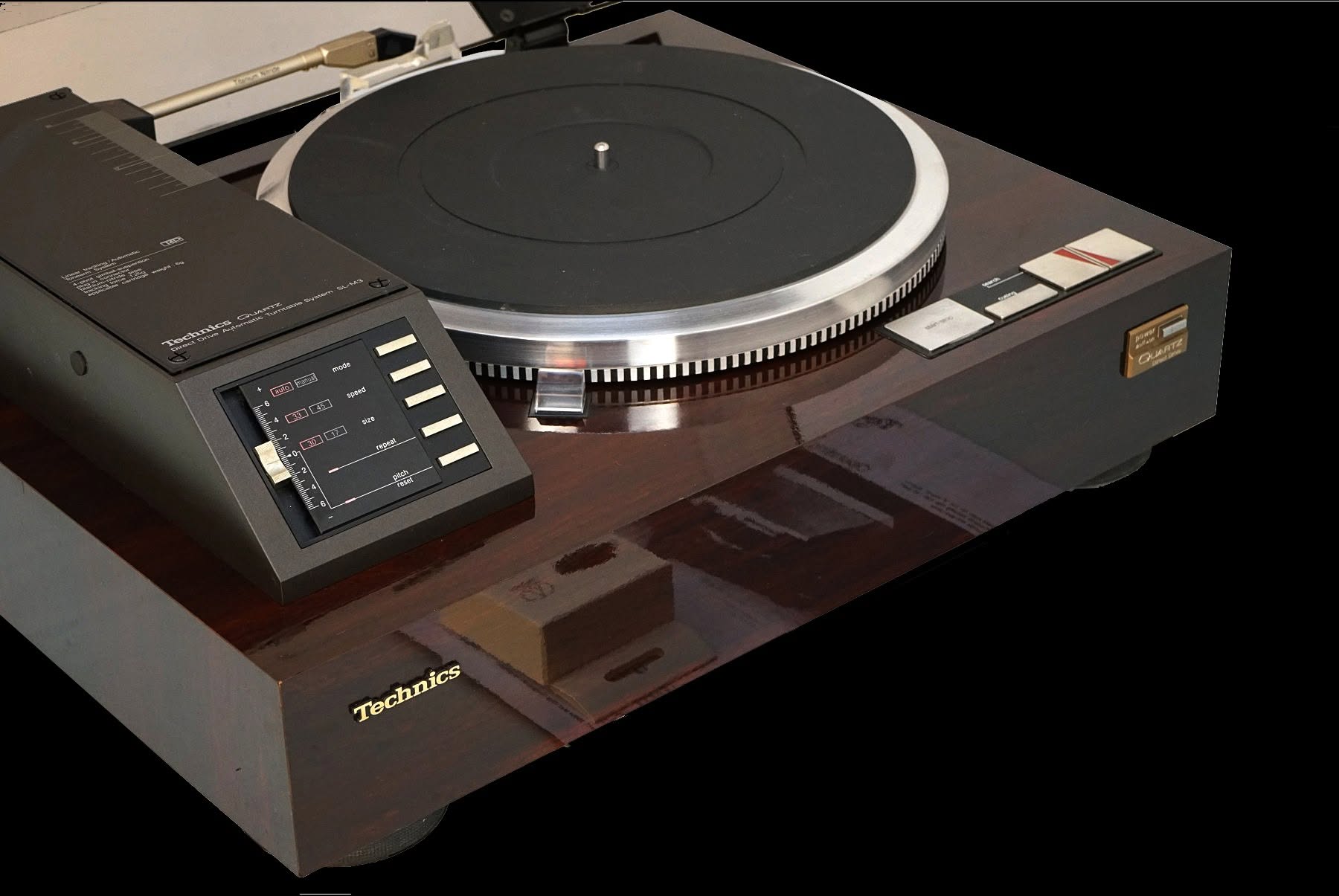
The SL-M3, offered from about 1984 to 1988, looks like a classic turntable at first glance. However, under its massive hood works a highly complex, fully automatic tangential player with quartz-controlled direct drive and servo-controlled tonearm.
Today, it is among the rarest Technics turntables from the 1980s. Professionally restored examples are now offered for around3,100 eurosoffered. A device described as like new is even available for3,200 US dollarsOn the market. However, it is important to distinguish: These are verifiable dealer or offer prices – not automatically proven sales revenues.
Why do dealers demand such sums today for a turntable that originally cost about 450 US dollars?
A turntable against the spirit of the times
The SL-M3 appeared at a very unfavorable time. In the mid-1980s, the compact disc was considered the future of music listening. Laser scanning, digital track selection, and supposedly wear-free playback dominated advertising and trade press.
While the HiFi world was excited about the CD player, Technics presented a 15-kilogram turntable with direct drive, tangential tonearm, extensive control electronics, and an elaborately crafted chassis.
The restoration company LiQUiD AUDiO, specialized in Technics, considers this timing to be a crucial reason why the SL-M3 has remained relatively unknown to this day. Technically, it offered almost everything vinyl listeners had wished for just a few years earlier: extremely stable speed, very low running noise, automatic operation, and tangential tracking.LiQUiD AUDiO: Technics SL-M3 Repair & Service
Thus, the SL-M3 was almost an analog counter-design to the CD player – user-friendly, precise, and futuristic, yet still completely committed to vinyl.
The tonearm doesn't rotate – it moves across the record
In a conventional pivoting tonearm, the needle moves in a circular arc over the record. However, since the cutting stylus is guided straight over the lacquer film when producing a record, a varying tracking angle inevitably occurs with traditional tonearms.
The SL-M3 follows a different principle: its tonearm is moved in a sled parallel to the record groove over the drive. A servo system detects the smallest lateral deviations of the arm and adjusts the sled accordingly.
This keeps the tracking angle constant over almost the entire record. Especially in the inner grooves, where distortions can become more noticeable with improperly adjusted pivoting tonearms, the tangential principle has a theoretical advantage.
The tonearm doesn't actually 'anticipate' the groove, as is sometimes said a bit overenthusiastically. Technically correct: The system detects a minimal angular deviation and then corrects the position of the carriage. It's this precise, continuous regulation that makes the SL-M3 so fascinating - and so demanding in case of repair.
Direct drive with Quartz Lock
Technics was one of the most important developers and pioneers of direct drive. In the SL-M3, the platter practically forms part of the motor. A belt or idler is not needed.
The speed is monitored via a quartz-based PLL regulation. The system continuously compares the actual speed with an electronic reference and corrects possible deviations.
The heavy aluminum die-cast platter has a diameter of 325 millimeters and weighs about 2.5 kilograms. The drive plays at 33⅓ and 45 revolutions per minute. Additionally, a speed correction of about ±6 percent is available.
In the technical documentation and various historical overviews, two values for the wow and flutter appear:0.008 percentas manufacturer-specific measurement and0.022 percent WRMS according to JIS. The more conservative value and more commonly cited in service documents is 0.022 percent WRMS. The rumbling noise increases with up to–82 dBspecified.Technics SL-M3 - technical data at Vinyl Engine
Even these values show that Technics did not develop the SL-M3 as a lifestyle product, but as a serious precision turntable.
The technical specifications of the Technics SL-M3
| Feature | Technics SL-M3 |
|---|---|
| Production period | approximately 1984 to 1988 |
| Origin | Japan |
| Design | fully automatic tangential turntable |
| Drive | quartz-controlled direct drive |
| Motor | brushless DC motor |
| Regulation | PLL Quartz Lock |
| Speeds | 33⅓ and 45 RPM |
| Pitch control | approximately ±6 % |
| Turntable | aluminum die-casting |
| Platter diameter | 325 mm |
| Platter weight | about 2.5 kg |
| Wow and flutter | 0.022 % WRMS according to JIS; partly specified as 0.008 % |
| Rumble distance | up to –82 dB |
| Tonearm | dynamically balanced tangential tonearm |
| Effective tonearm length | 238 mm |
| Effective mass | about 13 g including cartridge |
| Cartridge mount | T4P/P-Mount |
| Typical tracking force | 1.25 g, depending on the cartridge |
| Dimensions | about 526 × 205 × 425 mm |
| Weight | about 15 kg |
| Operation | fully automatic and manual |
| Original list price | depending on the market and source approximately 415–450 US dollars |
Historical American buying guides listed the SL-M3 in the mid-1980s at around 415 or 450 US dollars. Adjusted for inflation, that already corresponds to a significantly four-digit amount today. So the SL-M3 was never a cheap mass-market turntable.
T4P: comfortable, precise - but today a bottleneck
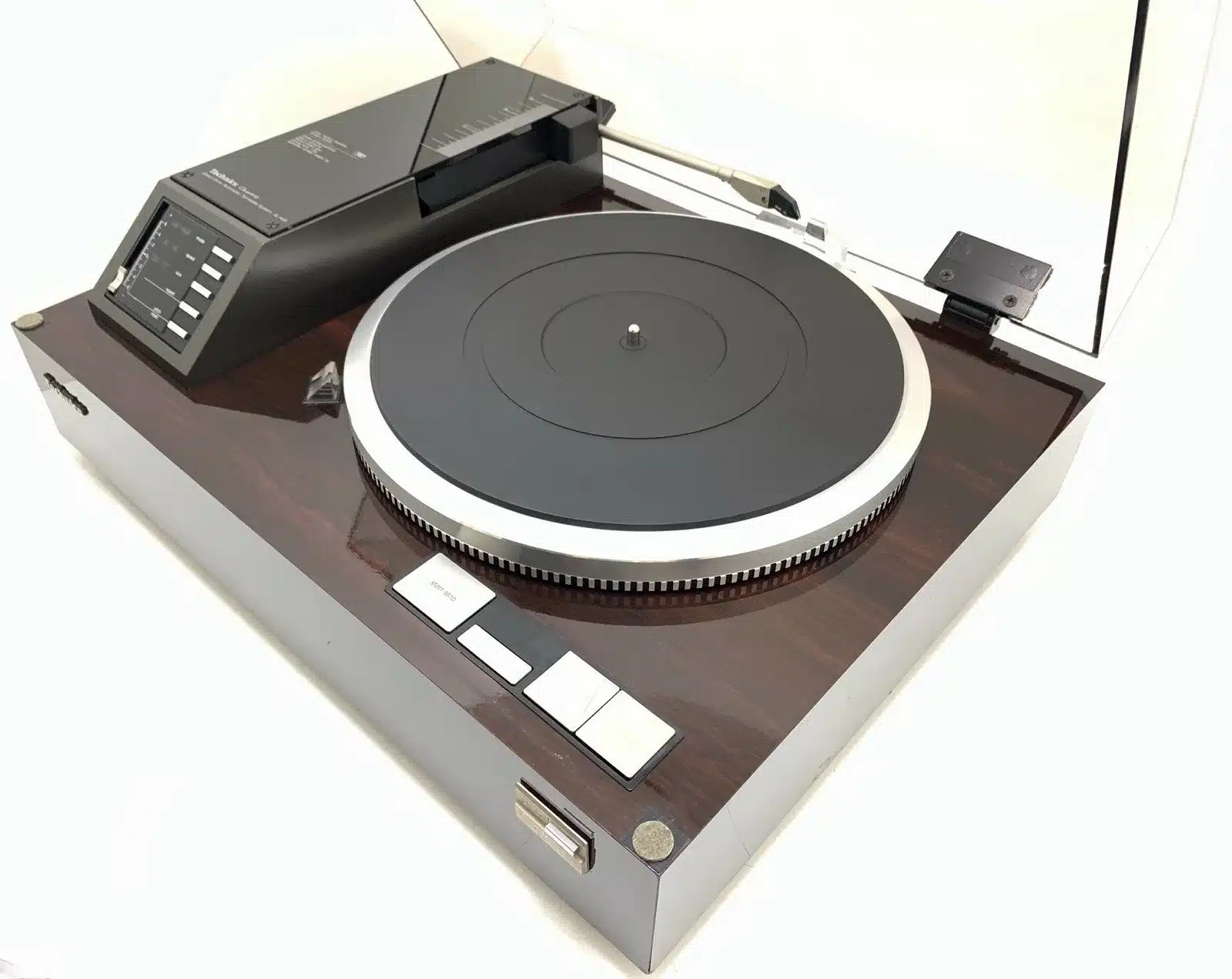
Technics relied on the T4P or P-Mount system developed by Technics for the SL-M3. The cartridge is plugged directly into the tonearm and secured with a screw.
Weight, stylus compliance, geometry, and tracking force were largely defined within the T4P standard. The owner did not have to complicatedly adjust the overhang or painstakingly align the cartridge in a headshell.
In the 1980s, this was an exceptionally elegant solution. Today, it's also a weakness, as the selection of high-quality new P-Mount cartridges is limited.
Particularly sought after are historical Technics systems like the EPC-P205C in its various versions or high-quality T4P models from Audio-Technica, Ortofon, and Shure. A well-preserved original system with an intact stylus holder can significantly increase the value of an SL-M3. For rare systems, a professional retipping or stylus overhaul can cost several hundred euros.
The originally supplied cartridge configuration could also vary depending on the sales market and version. Therefore, one shouldn't automatically refer to every high-quality Technics system mounted today as standard original equipment.
How does the Technics SL-M3 sound?
Major contemporary individual tests are hard to find today. The SL-M3 appeared more often in buying guides and model overviews than in detailed editorial comparison tests. Therefore, one shouldn't present modern reviews as if they were lab tests from back then.
The consistent listening impressions from owners and restorers still paint a clear picture:
- exceptionally quiet background
- very stable pitch
- precise and controlled playback
- low audible drive noises
- good channel separation and clean imaging
- low distortion in the inner grooves
- neutral instead of artificially warm sound tuning
One owner describes the SL-M3 after an overhaul as very quiet, well-isolated against footfall noise, and pleasantly musical. In direct comparison with a high-quality Roksan Xerxes turntable, the Technics, in their opinion, didn't reach its ultimate resolution but impressed with its smooth operation and exceptional ease of use.
LiQUiD AUDiO comes to a similar conclusion after a complete mechanical and electronic overhaul: A properly adjusted SL-M3 with the right cartridge can seriously compete with many other turntables.
This is a realistic assessment. The SL-M3 is not a magical device that automatically beats every modern high-end turntable. However, it combines very good measurements with a mechanical and electronic consistency that is rarely found in today's devices.
An analog robot
The SL-M3 looks like a classic turntable, but inside it's an electromechanical machine.
In addition to the direct drive, a separate mechanism works for the tonearm sled. Guide rails, worm drives, belts, gears, sensors, switches, and control electronics must work together precisely. The player largely takes care of starting, lowering, guiding the tonearm, automatic shut-off, and return.
It is exactly this construction that generates a large part of its fascination today: The SL-M3 is not just a turntable, but a working example of Japanese engineering from an era when manufacturers were willing to invest significant development work into analog comfort features.
Vintage Vinyl | mySoundbook
There are turntables that were built to reach as many buyers as possible. Others are mainly meant to look good. And then there's the Technics SL-M3: a device that apparently came about because Japanese engineers wanted to show what is technically possible when cost, weight, and mechanical effort are not the top priorities.
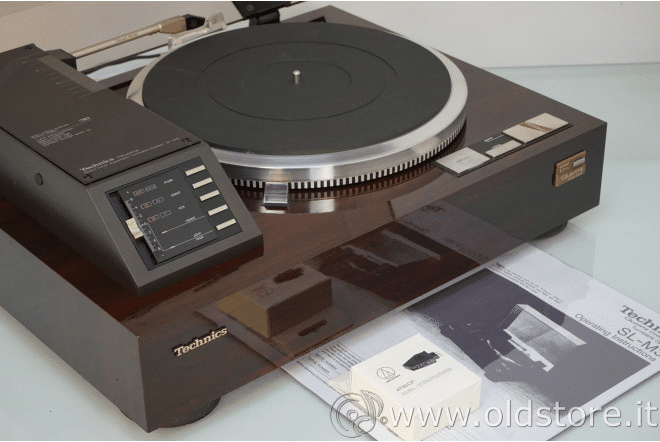
The SL-M3, offered from about 1984 to 1988, looks like a classic turntable at first glance. However, under its massive hood works a highly complex, fully automatic tangential player with quartz-controlled direct drive and servo-controlled tonearm.
Today, it is among the rarest Technics turntables from the 1980s. Professionally restored examples are now offered for around3,100 eurosoffered. A device described as like new is even available for3,200 US dollarsOn the market. However, it is important to distinguish: These are verifiable dealer or offer prices – not automatically proven sales revenues.
Why do dealers demand such sums today for a turntable that originally cost about 450 US dollars?
A turntable against the spirit of the times
The SL-M3 appeared at a very unfavorable time. In the mid-1980s, the compact disc was considered the future of music listening. Laser scanning, digital track selection, and supposedly wear-free playback dominated advertising and trade press.
While the HiFi world was excited about the CD player, Technics presented a 15-kilogram turntable with direct drive, tangential tonearm, extensive control electronics, and an elaborately crafted chassis.
The restoration company LiQUiD AUDiO, specialized in Technics, considers this timing to be a crucial reason why the SL-M3 has remained relatively unknown to this day. Technically, it offered almost everything vinyl listeners had wished for just a few years earlier: extremely stable speed, very low running noise, automatic operation, and tangential tracking.LiQUiD AUDiO: Technics SL-M3 Repair & Service
Thus, the SL-M3 was almost an analog counter-design to the CD player – user-friendly, precise, and futuristic, yet still completely committed to vinyl.
The tonearm doesn't rotate – it moves across the record
In a conventional pivoting tonearm, the needle moves in a circular arc over the record. However, since the cutting stylus is guided straight over the lacquer film when producing a record, a varying tracking angle inevitably occurs with traditional tonearms.
The SL-M3 follows a different principle: its tonearm is moved in a sled parallel to the record groove over the drive. A servo system detects the smallest lateral deviations of the arm and adjusts the sled accordingly.
This keeps the tracking angle constant over almost the entire record. Especially in the inner grooves, where distortions can become more noticeable with improperly adjusted pivoting tonearms, the tangential principle has a theoretical advantage.
The tonearm doesn't actually 'anticipate' the groove, as is sometimes said a bit overenthusiastically. Technically correct: The system detects a minimal angular deviation and then corrects the position of the carriage. It's this precise, continuous regulation that makes the SL-M3 so fascinating - and so demanding in case of repair.
Why a restoration is so elaborate
After more than 40 years, many SL-M3 suffer from similar signs of aging:
- worn or hardened belt of the tonearm carriage
- resinous lubricant on guide and worm drive
- stiff or stuck tonearm carriage
- incorrectly set pickup point
- aged switches and contacts
- damaged lid hinges or covers
- fluctuating reference values outside of quartz lock operation
- worn or damaged stylus
- transport damage due to improper packaging
In a proper restoration, it is not enough to just install a new belt. The tonearm mechanism must be disassembled, cleaned, re-lubricated, and then adjusted. The reference frequency and platter brake must also be checked according to service specifications.
In a documented repair case, the internal reference frequency had dropped from the required approximately 262.080 kHz to only 233 kHz. Only after mechanical maintenance and electronic calibration did the device work correctly again.Technics SL-M3 service manual as PDF
Here lies an important part of the pricing: A truly restored SL-M3 means numerous hours of work by a technician who understands both analog drives and complex servo controls.
Why is over 3,100 euros being asked?
A European vintage dealer currently offers an SL-M3 described as fully restored for3,100 eurosA like-new American example was listed at3,200 US dollarslisted.Audio Vintage Shop: restored Technics SL-M3
eBay listing: Technics SL-M3 for 3,200 US dollars
These prices can be explained by several factors:
1. The SL-M3 is rare
The model was never sold in the quantities of an SL-1200 or SL-1210. Many units disappeared during the CD boom, were damaged, or disposed of due to faulty automation.
2. It is heavy and complexly built
A 15-kilogram turntable with a large die-cast chassis, solid plinth, tangential arm, and complex control electronics would be expensive to produce today.
3. Working examples are becoming fewer
An outwardly beautiful SL-M3 is not automatically technically sound. Fully functioning, correctly calibrated, and professionally maintained devices make up only a small part of the offering.
4. Restorations are labor-intensive.
Specialists must master mechanics and electronics. Repairing a tangential arm can be significantly more complex than maintaining a simple manual turntable.
5. Original parts and cartridges are in demand.
Original covers, controls, protective covers, hinges, and high-quality P-Mount systems have significant individual value.
6. Technics is collected worldwide.
The brand's return to the high-end segment has also increased interest in historical top models. In addition to SP-10, SL-1000, SL-10, and SL-15, the rare SL-M3 is now also coming into focus for collectors.
7. It offers something that modern drives hardly provide anymore.
The market is full of manual turntables. It's hard to find a large, quartz-controlled direct drive with a fully automatic tangential arm among today's new devices.
Is 3,100 euros really realistic?
As a dealer price for an optically outstanding, technically fully restored device with warranty, documentation, and high-quality cartridge, 3,100 euros can be justifiable.
But that doesn't mean every SL-M3 holds that value.
An unchecked or repair-needing example can be worth significantly less. The supposed savings disappear quickly when tonearm sleds, controls, covers, and cartridges need to be refurbished. Additionally, asking prices do not represent actual market prices.
Therefore, before buying, you should have the following functions demonstrated:
- stable operation at 33⅓ and 45 RPM
- correct locking of the quartz lock control
- smooth movement of the tonearm sled
- precise start and end point
- trouble-free automation
- working manual control
- quiet platter bearing and low-noise motor
- undamaged cover and hinges
- Condition of needle and needle holder
- Proof of completed restoration work
Particularly during shipping, caution is advised. The platter, tonearm, and moving parts must be secured according to manufacturer specifications. A 15-kilogram tangential turntable should not be shipped like an ordinary package.
Conclusion: Technics built the turntable of the future – just before everyone believed in the CD.
The Technics SL-M3 comes from a time when Japanese manufacturers weren't afraid to develop elaborate technical solutions to production maturity. It combines a heavy direct drive with quartz lock, a servo-controlled tangential tonearm, full automation, and a build quality that impresses even four decades later.
It doesn't intentionally sound warm, romantic, or nostalgic. Its strengths are calmness, precision, neutrality, and a steady pace. This makes it surprisingly modern even today.
The prices of around 3,100 euros don't just come from audiophile performance. They result from rarity, collector interest, complicated restoration, high manufacturing quality, and the fact that hardly anyone builds a comparable turntable today.
The Technics SL-M3 is therefore more than a vintage turntable. It's an analog robot, a technical document, and one of the most interesting turntables Technics built during the great Japanese HiFi era.
Or put a bit less soberly:The Technics SL-M3 is no ordinary turntable. It's a machine with personality – and that's exactly why it's being rediscovered today.
SEO Title:Technics SL-M3 in Vintage Portrait: Why the tangential turntable costs over 3,100 euros
Meta Description:The Technics SL-M3 was one of the most extraordinary tangential turntables of the 1980s. All technical data, sound impressions, weaknesses, and reasons for prices over 3,100 euros.
URL Suggestion:technics-sl-m3-vintage-turntable-test-data-price
SEO keywords:Technics SL-M3, Technics turntable vintage, tangential turntable, linear tracking turntable, Technics direct drive, Technics SL-M3 test, Technics SL-M3 price, vintage hi-fi, quartz direct drive, P-mount cartridge, Technics turntable from the 1980s