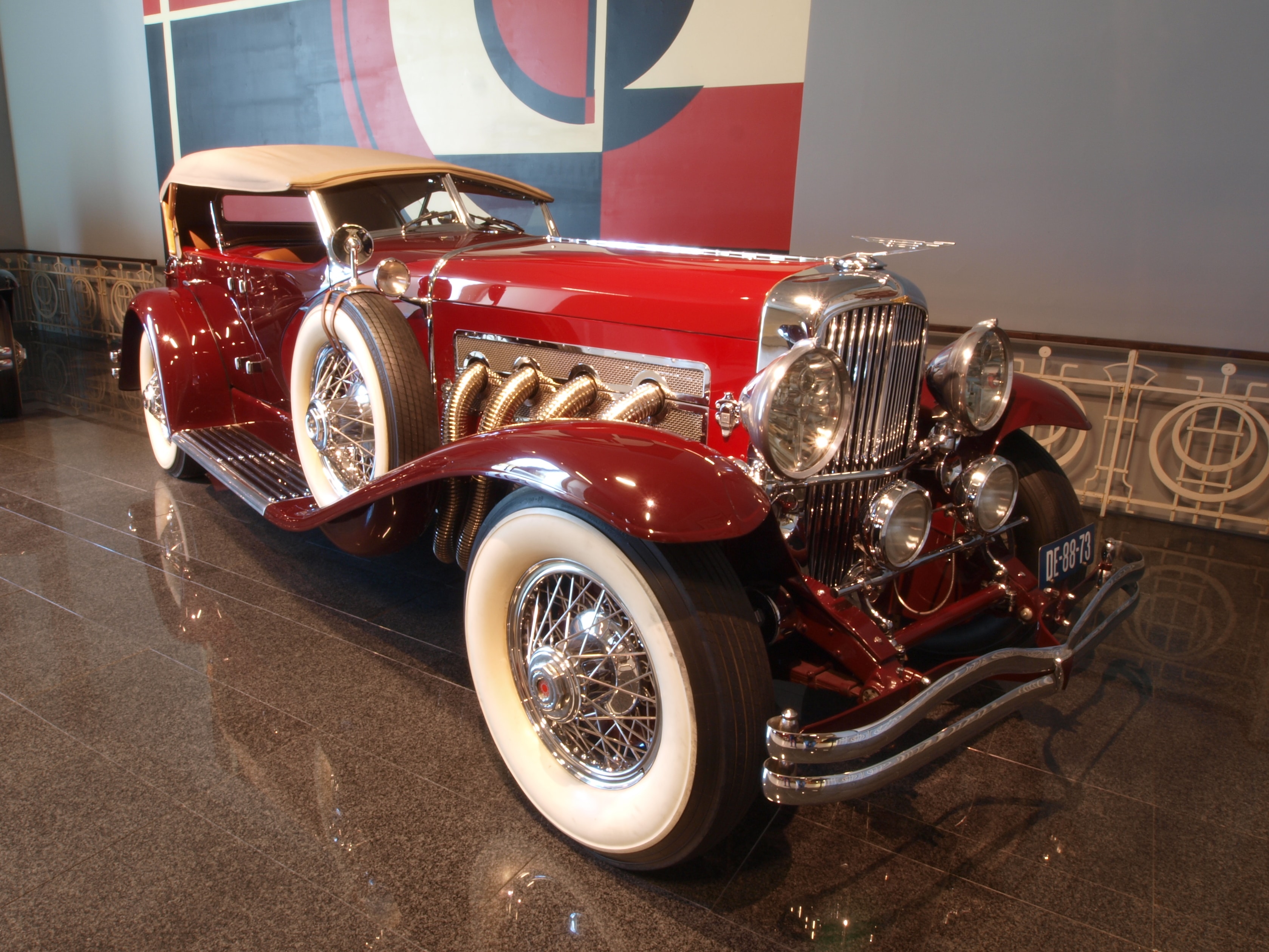

The nameDuesenberg guitarshas its origin in the passion of the founder Dieter Gölsdorf for the style of the 40s and 50s. In the 20s, there was in the USA theDuesenberg Motor Company, a car manufacturer that built particularly beautiful cars back then. We want to take a look at the eventful and exciting history behind the Duesenberg Motor Company.
The Duesenberg Motor Company & the golden age of Duesenberg automobiles
The Duesenberg Motor Company was founded by the brothersFriedrich(Fritz, later Frederick, Fred; 1876–1932) andAugust(later called Augie; 1879–1955) Düsenberg. Both were born in Lemgo / North Rhine-Westphalia. In 1895, the mother emigrated with her six children to Iowa / USA. Soon, theüin the name would be replaced with aueexchanged.
The beginnings of developments in 1897 were not yet in the car but in the manufacture of bicycles. From 1902, Fred dedicated himself to tuning cars from other manufacturers. After the company's bankruptcy, the brothers were employed at the Mason Motor Company in Des Moines (Iowa), for which they developed the Marvel.
In 1913, it was finally time and theDuesenberg Motor CompanyDMC was founded in St. Paul, Minnesota. The first developments were a four-cylinder engine and an inline eight-cylinder engine with 4.3 liters of displacement and 90 hp. During World War I, DMC supplied engines for boats and airplanes of the British Army and to France. After the war, Duesenberg returned to car production. In addition to successes in the Indianapolis race, a Duesenberg set a world record of 251 km/h in 1920; in 1921, a Duesenberg won the Grand Prix of France in Le Mans. From 1921, theproduction vehicle of the Duesenberg Model A with a 4.3-liter inline eight-cylinder engine, which was further developed into the Model X in 1926.
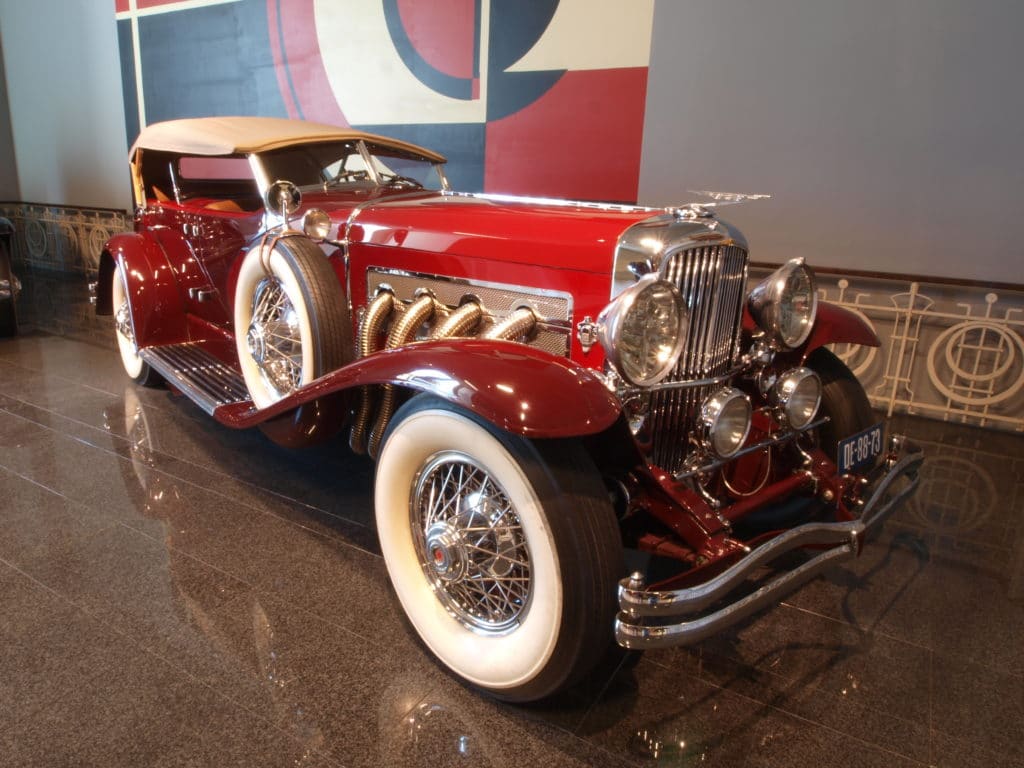
In 1926, the company was sold toErrett Lobban Cordsold. The Duesenberg brothers remained with the company in management positions. Subsequently, vehicles and engines for the brands Auburn, Cord, and Duesenberg were developed and built together – a practice similar to how Bentley and Rolls-Royce operated after their merger in Europe. The cars were now produced in the Auburn halls. In the holding of the Cord Company, Duesenberg consistently produced the top models with the highest reputation and also the highest prices among all brands.
The Duesenberg models were pioneering, not only due to their reliability but also with technical solutions – featuring hydraulic brakes, DOHC four-valve technology, and supercharging – even in the civilian versions driven by kings, movie stars, and gangster bosses. The model introduced in 1929Duesenberg Model Jhad a displacement of 6.9 liters, a power output of 265 hp, and a top speed of 180 km/h. Its successor, the SJ, had a supercharged engine and reached 320 hp and a top speed of 243 km/h in 1932.
Duesenberg delivered only engines and chassis, as was typical at that time. The bodies were custom-made by coachbuilders, saddlers, and carpenters according to customer specifications. Among them were the most expensive and exclusive companies in the industry, such as Derham, LeBaron, Murphy, Rollston, and Waterhouse. There were and are no two identical Duesenbergs – each vehicle was unique. Only in 1930 did Duesenberg launch its own program of factory-offered bodies.
The new price of aSJwould today be around 1.5 million euros. Duesenberg could afford to choose its customers. It wasn't enough just to present the corresponding purchase price. Only if the customer met the Duesenbergs' expectations would a deal be made. When the first Duesenbergs appeared in the gangster circles of Chicago and New York, and bank robberies were committed with them, where the fast vehicles served as getaway cars, the Duesenberg brothers were very concerned about the reputation of their brand.
Duesenberg also produced a W24 marine engine, with which H. E. Dodge Jr. (son of Horace Elgin Dodge) first broke the 100 mph barrier (about 161 km/h) on water in 1937.
On July 26, 1932, Fred had a fatal accident while driving back over Ligonier Mountain, Pennsylvania, after work. With Fred Duesenberg's death, the company lost its brilliant designer. His brother August outlived him by more than twenty years; he died on January 19, 1955.
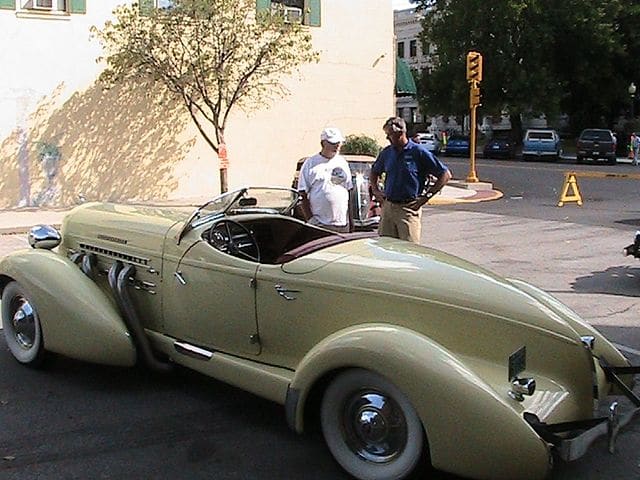
Duesenberg today – sought after and rare
Duesenberg cars are traded for around a million US dollars, sometimes at auctions. Sales of Duesenberg cars have been countable on one hand over the last decade; once someone has a 'Duesie', they usually don’t let it go. Duesenberg sales since 1970 have mostly happened only after the owners' deaths, like during the dissolution of the 'Harrah's Collection' from William F. Harrah, a casino owner in Nevada, whose car collection went on a European tour after his death beforeit was auctioned off in parts. Among other things, an Auburn Speedster and all three Duesenberg cars from Harrah were on display in June 1979 at the Old Fair in Düsseldorf. About half of the roughly 650 Duesenberg ever made are said to still be drivable. Other sources mention 470 produced vehicles.
Only about 30 of the produced Duesenberg cars made it to Europe; a large part of them did not survive the war turmoil. The reputation of Duesenberg cars in the USA is comparable to that of Rolls-Royce vehicles by European standards, but in addition to the luxury of the high price, it also comes with the plus of high performance and sportiness. The cars are considered the ultimate in contemporary automobile construction by their followers.
The Duesenberg brand influenced American slang. With the statement 'It's a doozy!‘ was originally used in the 19th century to describe something as beautiful, 'doozy' was the slang form of 'daisy'. However, after the appearance of Duesenberg vehicles, a change in meaning occurred. The phrase now marks an object as extravagant. Due to phonetic similarity, the spelling 'It's a duesy!”
A well-known collector of Duesenbergs is the American hostJay Leno. Besides his considerable number of cars from various automotive eras, he also owns rare Duesenbergs from the years 1920 and 1930.